Showing posts with label multiplication. Show all posts

Friday, October 18, 2024

Hip Hip Array!


We have been exploring arrays!


Row x Column = Product

The multiplication for the array above is
3 x 4 = 12
because it has 3 rows of 4.


When the factors are different digits, 
the arrays are in the shape of a rectangle. 

When the factors are the same digit, 
the array is a square!


Here are some arrays we found around campus!


3 rows of 3 
3 x 3 = 9 hearts


3 rows of 4 
3 x 4 = 12 green squares


3 rows of 11 
3 x 11 = 33 rectangles


10 rows of 10 
10 x 10 = 100 squares
This is a very famous array!


5 rows of 7 
5 x 7 = 35 dots


3 rows of 4
3 x 4 = 12 window panes


Do you see any arrays in your life? Tell us about them in the comments!


Monday, November 28, 2016

An Array of Compound Words


Today we reviewed compound words. 

First, we watched the BrainPop Jr. video.


Something new to students was the idea of different types of compound words. For this, we stopped by the teacher resources from Spelling City


There are THREE different types of compound words, closed, hyphenated, and open compound words! 


Next, Mrs. Yollis got out some compound word cards. Each student was given half of a compound word. The object was to find a student with the other half. Together two students made ONE compound word. 


Once all the compound words were formed, we started making an array to figure out how many compound words we had in all. An array is a multiplication word we recently learned. When you line up objects in equal rows and columns, it makes it easy to get the total, or product

The first attempt is shown below. Students thought they had eight rows of four. So, 8 x 4 = 32 compound words.

Students soon realized that we had eight rows. However, some rows had four compound words and some rows had three compound words.  

We did some figuring, and realized we had 30 words.


Once we realized we had 30 words, we started building real arrays. 


6 rows of 5


15 rows of  2


2 rows of 15


3 rows of 10


What arrays did we miss? 

Leave a comment using at least FOUR compound words! 


Saturday, December 19, 2015

Multiplication! Multiplication! Multiplication!


We are learning and loving multiplication! 
Multiplication is repeated addition. 


4 + 4 + 4 = 12

3 groups of 4 balloons = 12 balloons
3 and 4 are factors
12 is the product


We've done a plethora of activities to clarify the properties of multiplication and memorize the facts! We have been attacking multiplication in a multitude of ways! 


Playing Multiplication Games
Thanks Marcy Cook 


Making Multiplication Bracelets!


Multiplication Tricks and Patterns for 9s!


Multiplication Bingo!


Making Arrays and Applying the Distributive Property of Multiplication 

The Distributive Property states that multiplying a sum by a number is the same as multiplying each addend by the number and then adding the products


6 x 7


We've even been writing about the Distributive Property of Multiplication over on our 365 Blog. 


Aaron's 324 x 5 example:


Keya's 7 x 8 example:


Students have photographed arrays to share on our class 365 blog


In the comment section, leave an equation for one of the following photos! Challenge, can you then apply commutative property or distributive property to your equation? Try to take your comment to a higher level! Here we go!

1. Mrs. Yollis' pan array 


 2.  Kostaki's picture array


3. Kostaki's bead array


4. Keya's pumpkin seed array


5. Ari's shoe array


6. Kate's pencil array 


7. Abigail's chalk array  


8. Keya's tile array


9. Lily's crayon array


Advanced: This array uses 3 factors and a set of parenthesis. Good luck!


10. Mrs. Yollis' cup cakes


Again, in the comment section, leave an equation for one of these photos! Challenge, can you then apply commutative property or distributive property to your equation? Try to take your comment to a higher level!


What is your favorite multiplication equation?

Which math fact is the most difficult for you? 

Friday, December 12, 2014

Tutorial: A Multiplication Strategy


REMINDER: Edublog Award voting is open until December 15. We are nominated in THREE categories. Please consider voting!  Click here to give us your thumbs up/like. 

We have been learning about multiplication. 


Sometimes we encounter a large multiplication sentence and we don't know the product. We learned a strategy called:  Break the Large Array into Two Smaller Arrays and Add the Products


Here is a fabulous tutorial explaining the process 

for 5 x 7 = ?


Here is another tutorial. Again, it is modeling how to split a large array into two smaller arrays to get the final product. 


What did you think of the multiplication strategy?

What did you think of the tutorial?

Give us a large multiplication sentence that we can practice splitting into two smaller arrays to solve.

Wednesday, January 30, 2013

Multiplication/Division Pixie Problems!


Mrs. Yollis' third graders have been working with the computer teacher, Mrs. Minicozzi, to write multiplication and division story problems. 

First, students chose a X/÷ fact family and wrote the four equations

Example: 

6      7     42

6 x 7 = 42
7 x 6 = 42
42 ÷ 7 = 6
42 ÷ 6 = 7


Second,  students selected one of the fact family equations.

Third, students wrote a story to match the math equation. Fictional characters were used as the main characters.

Finally, students used the computer program called Pixie to illustrate their story problems. 


Enjoy!

Word Problems by Mrs. Yollis's class


What was the most difficult part about creating your Pixie pages? 

What advice would you give others who are using Pixie?

Make up another word problem in the comment section!

Thursday, October 20, 2011

Hip Hip Array!


We have been exploring arrays!

Row x Column = Product

The multiplication for the array above is
3 x 4 = 12
because it has 3 rows of 4.

When the factors are different digits, 
the arrays are in the shape of a rectangle. 
When the factors are the same digit, 
the array is a square!
Here is a quiz. 
Be sure your math sentence matches the picture!
Rows   x   Columns on PhotoPeach
Do you see any arrays at your house? Tell us about it!


Wednesday, January 7, 2009

Multiplication Property Games

By Shane F., Sean, and Matthew


In our multiplication unit we have been playing games to help us learn the properties of multiplication.

Order Property of Multiplication Game

A few weeks ago, Mrs. Yollis made two yellow factor cards, and she picked two people to be "factors". The "factors" chose a number from her box of digits.


Next, they hid their number under their yellow factor card.


When Mrs. Yollis yelled, "Name the product!" the two factors revealed the factors to the class.


The class wrote down the multiplication sentence with the correct product.


Students with the correct product could then be chosen to be part of the game.


We learned that if you switch the order of the factors, the product stays the same.

8 x 9 = 9 x 8


Grouping Property of Multiplication Game

Today, we learned to multiply three factors! Mrs. Yollis made another yellow factor card and a set of cardboard parentheses. We learned a new game for this property.

* * *

Three students were chosen to be the "factors". They hid a number under their factor card. One at a time the numbers were shown. When all three factors were revealed, Mrs. Yollis allowed one person to be the grouper. (An organizer, not the fish!)


That grouper came up and grouped two of the factors with the parentheses. The class wrote the newly grouped factors in a number sentence on their white boards and solved the equation.


Students with the correct product could become a new "factor" or the grouper.

We learned that it doesn't matter how you group the factors.


(1 x 2) x 5 = 1 x (2 x 5)


The product will always be the same.
We also learned that grouping certain factors together made it easier to come up with the product.

Perhaps you would like to play the games too!

Monday, December 8, 2008

Hip Hip Array!


The concept of multiplication is our current unit of study in math. Multiplication is repeated addition. We have also learned about arrays.

Our math glossary defines an array as: An arrangement of objects in rows and columns.

ROWS go across.

C
O
L
U
M
N
S

g
o

d
o
w
n


* * * * * * * * * *


Here are some arrays we found around our school. Notice how we used synonyms for the word see!


While I was reading a book outside at recess, I glanced over and saw an array of windows.

3 x 4 = 12 windows

Taylor S.


When I was seated at my desk, I peeked over my chair and saw an array of giant paper coins.

2 x 5 = 10 giant coins

By Matthew


When I was at my desk, I spied an array of pictures called Take your Acorn on Vacation. There were four rows of two.

4 x 2 = 8 vacation photos
By Behyan


When I was looking at the world map, I noticed there was an array of squares in the map key.

2 x 5 = 10 land and water squares

By Shane F.


While I was outside on the jungle gym, I glanced across the yard and saw an array of benches.

1 x 4 = 4 benches

By Kyle


While I was in the library, I observed an array of math books.

7 x 4 = 28 math books

By Lexi


When I was sitting in class, I looked at the computers and I saw an array.

1 x 3 = 3 computers

By Shane J.


I was in the P.E. equipment shed, and I saw an array of bowling pins.

2 x 4 = 8 pins

Taylor G.


While I was seated at my desk, I spotted a Parts of Speech poster array.

3 x 2 = 6 Parts of Speech posters

By Sean


While I was walking around the classroom, I stopped and observed the elapsed time stories array.

2 x 8 = 16 elapsed time stories

By James


When I was walking by the world map, I spied an array of cubbies.

8 x 3 = 24 cubbies

By Amanda


While I was walking around the non-fiction section of the library,
I stared at the Zoo Book rack. The columns were easy to see. There were two columns.

Some students thought this was

2 x 23, rather than

23 x 2


Solution?

*

*

*


Rotate the picture!

Now you see two rows.

2 x 23 = 46 Zoo Books

By Chloe


When I was walking around the room, I spied the dictionaries. The two columns were easy to see. Some students thought
this was 2 x 10 rather than 10 x 2.

Solution?


*
*
*

Rotate the picture!


Now I see 2 rows x 10 = 20 dictionaries
By Alasia


The next few arrays are special. Both of the factors are the same and they make a square. We call them the square products!


When I was inside the classroom, I spied one row of one quarter.

1 x 1 = 1 quarter

By Emily


While I was walking around the classroom, I spotted our Chinese character stories in an array.

4 x 4 = 16 Chinese character stories

I also noticed that both factors are the same, so it is a square.
By Jonah


I stared at the board in the classroom and saw a penny array. I noticed it was a square. That means it has the same number of rows and columns.

5 x 5 = 25 pennies

By Warren


While I walked through a teacher's room, I looked at an array of boxes.

10 x 10 = 100 boxes

By Marcus


While I was strolling around the room, I looked at the multiplication chart. There were 13 rows and 13 columns.

14 x 14 = 116 squares
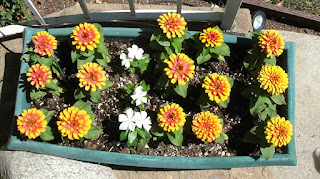


Here are two arrays of yellow and orange zinias that Mrs. Yollis planted.

I see 3 rows of 2 on the left.

I see 3 rows of three on the right.

How many yellow and orange zinnias?

Hint: Use multiplication and addition!


*


*


*

Answer:


(3 x 2) + (3 x 3)

6 + 9 = 15 yellow and orange zinnias!


Do you see any arrays in your life? Tell us about them in the comments!

* * * * *
Extra Credit from Shane J.!
Shane sent us a hyperlink to a photo of his French doors.
Can you name the array?